How BathSelect® Evaluates Bathroom Fixtures for Design, Installation, Serviceability & Long-Term Performance
This page explains the practical criteria BathSelect® uses when discussing faucets, showers, soap dispensers, finish options, installation requirements, serviceability, water use, commercial suitability, and long-term performance. The goal is to help homeowners, architects, designers, plumbing engineers, contractors, facility managers, hospitality teams, and commercial developers evaluate fixtures with more than appearance alone.
Why Fixture Evaluation Needs a Practical Framework
Bathroom fixtures affect more than style. A faucet, shower, soap dispenser, drain, valve, or finish selection can influence installation time, cleaning expectations, maintenance access, water use, guest experience, ADA planning, commercial restroom durability, and long-term ownership satisfaction. BathSelect® evaluates fixtures through a practical framework that combines review patterns, product specifications, installation feedback, finish-performance observations, maintenance language, and project-use context.
This framework is especially important for AEC audiences because fixture decisions often move from inspiration to documentation. A beautiful product still needs to fit the sink, match the finish schedule, work with the plumbing condition, support the maintenance plan, and meet the owner’s expectations for performance over time.
Evaluation principle: BathSelect® treats fixture performance as a combination of product quality, installation conditions, user behavior, cleaning routine, service access, and project context.
Core Evaluation Criteria
BathSelect® uses multiple criteria when explaining fixture performance. Each criterion answers a different question: how the product looks, how it installs, how it functions, how it is maintained, how it performs in a commercial setting, and how well it supports long-term ownership.
Design Fit
Evaluates style, finish coordination, scale, visual compatibility, luxury presentation, and how the fixture supports the bathroom concept.
Installation Readiness
Reviews mounting type, hole count, deck or wall condition, standard connections, valve compatibility, access needs, and installer clarity.
Finish Performance
Considers chrome, nickel, bronze, matte black, gold, and other finishes through cleaning, fingerprints, spotting, appearance, and long-term use.
Serviceability
Looks at maintenance access, batteries, cartridges, aerators, soap reservoirs, sensor components, replacement parts, and cleaning routines.
Water & User Performance
Considers flow, pressure, comfort, activation, splash control, water efficiency, user behavior, and daily usability.
Commercial Suitability
Reviews durability, traffic level, hygiene expectations, public use, guest experience, facility maintenance, and lifecycle planning.
Chart: Review Signals That Shape Fixture Evaluation
Review signals help identify which fixture issues deserve deeper explanation. These counts are used as practical indicators for article planning, not as laboratory test results or compliance certificates.
Review-Signal Distribution Used in Evaluation Criteria
Signals are organized into performance themes that support fixture evaluation and buyer education.
Design, Finish & Material Evaluation
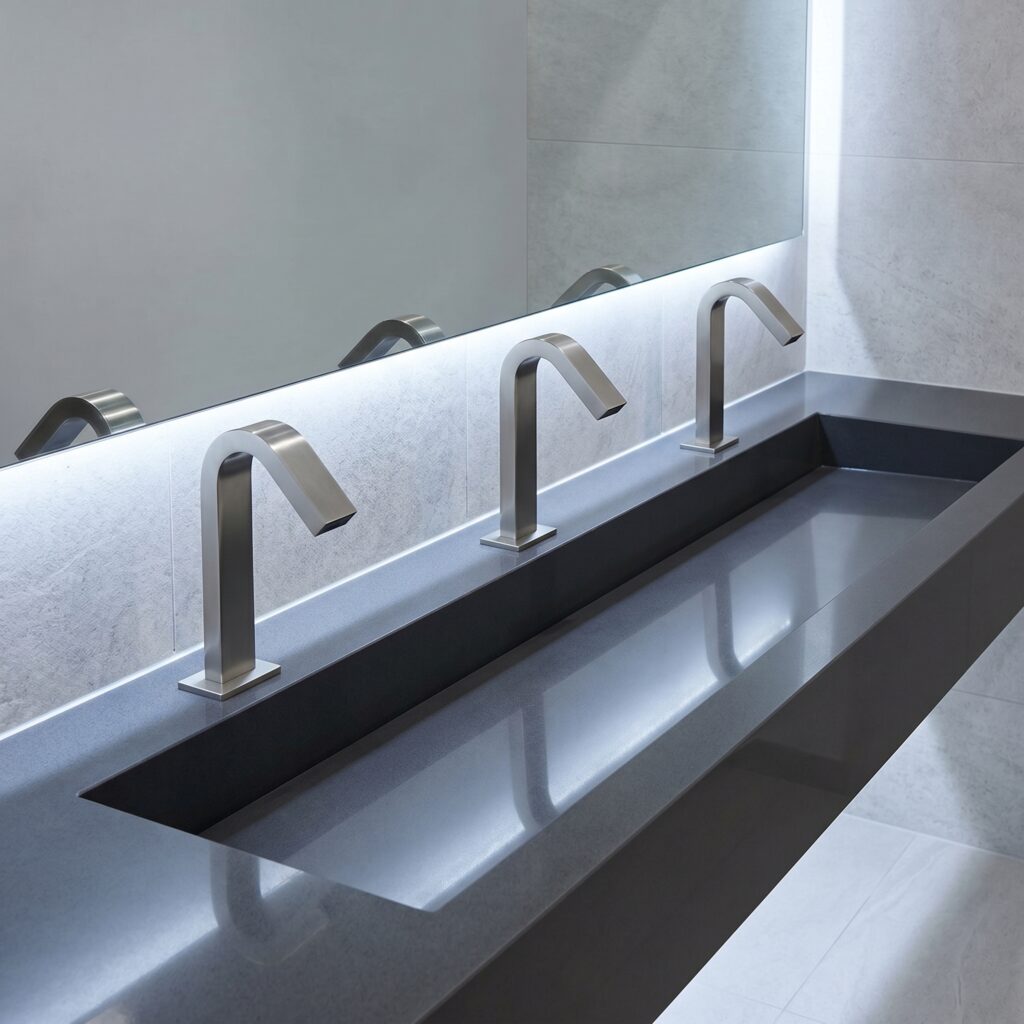
Design evaluation begins with proportion, finish, product form, and compatibility with the bathroom concept. BathSelect® also considers how a finish behaves after installation. A fixture may look strong in a product photo but still require clear expectations for fingerprints, water spotting, cleaning chemicals, daily use, and finish coordination with other hardware.
Material quality is reviewed through product information, customer language, construction references, and long-term ownership feedback. Solid brass, stainless steel, plated finishes, PVD-style finishes, glass, stone, and specialty surface materials are discussed in relation to durability, care, weight, appearance, and intended environment.
| Evaluation Area | What BathSelect Reviews | Why It Matters | AEC Planning Note |
|---|---|---|---|
| Visual fit | Fixture scale, shape, finish, handle style, spout reach, and coordination with sink, tub, shower, or counter design. | Visual fit affects design continuity, guest perception, homeowner satisfaction, and the finished bathroom experience. | Coordinate with finish schedules, fixture schedules, restroom elevations, and interior design intent. |
| Finish behavior | Cleaning expectations, water spotting, fingerprints, finish aging, matching, and surface appearance under frequent use. | Finish behavior affects maintenance workload, lifecycle appearance, and user satisfaction after installation. | Review cleaning protocols and confirm finish compatibility with owner maintenance standards. |
| Material construction | Solid brass references, stainless steel notes, body construction, weight, valve quality, surface materials, and durability language. | Material construction influences perceived quality, service life, and performance under repeated use. | Use product specifications and submittal data for project-level verification. |
| Design durability | How the fixture form supports daily use, splash control, cleaning access, and user interaction over time. | A design that is hard to clean or awkward to use may create long-term maintenance and satisfaction issues. | Evaluate not only appearance but also access, reach, clearances, and user behavior. |
Installation & Compatibility Evaluation
Installation is one of the strongest practical filters in fixture evaluation. BathSelect® reviews how a fixture is mounted, what connections it may require, whether access is available for service, and how clearly the product fits common installation conditions. This matters for homeowners, contractors, plumbers, designers, and architects preparing a coordinated bathroom package.
For commercial and AEC contexts, installation evaluation also includes repeatability. A fixture selected for many rooms, guest bathrooms, or public restrooms should be understandable for installation teams, compatible with project documentation, and serviceable after turnover.
Installation caution: Review feedback can identify common installation concerns, but it does not replace rough-in drawings, manufacturer instructions, plumbing code review, licensed installer judgment, or site measurements.
Confirm Mounting
Review deck, wall, counter, shower, tub, or under-deck mounting conditions before selection.
Check Connections
Confirm water supply, valve type, power source, soap tubing, or accessory requirements where relevant.
Plan Service Access
Evaluate access panels, under-sink space, battery location, cartridge access, and maintenance clearance.
Verify Documentation
Use product pages, installation instructions, spec sheets, and project drawings before final approval.
Fixture Evaluation Scorecard
The scorecard below shows the practical evaluation structure BathSelect® applies when discussing bathroom fixtures. The percentages are editorial weighting guidelines for article development. They are not product ratings, laboratory scores, or compliance determinations.
Chart: BathSelect Editorial Evaluation Weighting
Weighting helps keep articles balanced between design appeal and real-world performance criteria.
Serviceability, Maintenance & Long-Term Performance
BathSelect® evaluates fixtures by what happens after installation. Serviceability includes access to parts, cleaning difficulty, battery replacement, cartridge access, aerator care, soap refill routines, sensor calibration, and the ability to maintain appearance over time.
Long-term performance is influenced by product construction, water quality, frequency of use, maintenance routine, cleaning chemicals, installation accuracy, and user behavior. This is why BathSelect® articles connect review data with practical ownership guidance rather than treating every fixture as a purely decorative object.
Cleaning Routine
Evaluates how finishes respond to daily cleaning, water spotting, public restroom use, and maintenance-team procedures.
Replacement Access
Reviews access to cartridges, aerators, batteries, soap tanks, control boxes, and common service components.
Ownership Signals
Uses review language about reliability, durability, support, service, finish appearance, and performance after repeated use.
Water Use, Accessibility & Standards Context
Water use and accessibility require careful wording. BathSelect® may discuss WaterSense, ADA, ASME, NSF, IAPMO, LEED, and WELL references when a fixture topic touches water efficiency, plumbing fittings, lead-content standards, accessible lavatories, green building, or wellness-focused water concepts. These references support context; project teams must still confirm product-specific documentation, local code requirements, and project criteria.
| Evaluation Topic | What BathSelect Looks For | Useful Reference Context | Project Verification Needed |
|---|---|---|---|
| Water efficiency | Flow rate language, aerator behavior, user satisfaction, splash control, and water-use claims. | EPA WaterSense and LEED indoor water-use references. | Confirm actual flow rate, project baseline, owner standards, and required documentation. |
| Accessibility | Controls, reach, lavatory use, public restroom usability, and touchless operation where relevant. | ADA lavatory and sink guidance from the U.S. Access Board. | Confirm clearances, mounting heights, reach ranges, local code, and full accessibility review. |
| Plumbing fitting performance | Supply fittings, valves, spouts, accessories, and compatibility with the intended installation. | ASME A112.18.1 / CSA B125.1 plumbing supply fitting context. | Confirm applicable product listing, manufacturer documentation, and project specification requirements. |
| Potable-water material context | Material claims, lead-content discussion, brass components, and water-contact surfaces. | NSF / ANSI / CAN 372 lead-content standard context. | Confirm specific product listing and certification data before specification. |
| Commercial restroom planning | Public use, service access, durability, cleaning, user flow, and maintenance planning. | IAPMO UPC, LEED, and WELL references where applicable. | Confirm jurisdiction, owner standards, facility operations, and code consultant review. |
Commercial Suitability Evaluation
Commercial suitability is not based on appearance alone. BathSelect® evaluates how a fixture may perform in hotels, offices, healthcare facilities, restaurants, airports, public restrooms, and other high-use environments. The evaluation looks at durability, cleaning access, finish consistency, service requirements, replacement planning, and whether the fixture supports the intended user experience.
A commercial restroom fixture should be practical for installation teams, intuitive for users, manageable for maintenance staff, and durable enough for the expected use pattern. Review signals and product information help identify where an article should explain these requirements more clearly.
Chart: Commercial Suitability Factors
Commercial evaluation emphasizes lifecycle practicality, not just visual appeal.
Source Links Used for Evaluation Context
The source links below are provided for technical context. They help readers verify broader issues related to water efficiency, accessibility, plumbing fittings, lead-content standards, plumbing codes, sustainable building, and water-focused wellness. Product-specific compliance must always be checked separately.
EPA WaterSense
Bathroom faucet water-efficiency context and WaterSense fixture guidance.
Open SourceADA Lavatories & Sinks
Accessibility guidance for lavatories and sinks in accessible toilet and bathing rooms.
Open SourceASME A112.18.1 / CSA B125.1
Plumbing supply fittings standard context for faucets, fittings, and accessories.
Open SourceNSF / ANSI / CAN 372
Lead-content technical reference for drinking-water system components.
Open SourceIAPMO Uniform Plumbing Code
Plumbing code-development context for plumbing systems and water-efficiency planning.
Open SourceUSGBC LEED Indoor Water
Indoor water-use reduction context for green building and sustainable fixture planning.
Open SourceWELL Water Concept
Water quality and wellness context for facilities, interiors, and building occupant experience.
Open SourceBathSelect Research Database
Internal BathSelect review-history foundation used for practical customer-experience signals.
Open DatabaseBathSelect Main Site
Product and category reference for BathSelect bathroom and kitchen fixtures.
Open SiteEvaluation Limits
BathSelect® evaluation criteria are designed to make fixture articles more useful, transparent, and practical. They do not replace professional design review, engineering review, code interpretation, manufacturer documentation, product certification, field testing, or local jurisdiction approval.
| Evaluation Area | What BathSelect Content Can Explain | What Must Be Verified Separately |
|---|---|---|
| Product fit | Common selection factors such as style, mounting type, finish, and practical use. | Exact dimensions, rough-in requirements, installation manual, and site conditions. |
| Finish performance | Review patterns related to cleaning, appearance, spotting, fingerprints, and ownership satisfaction. | Finish warranty, cleaning chemical compatibility, coating specification, and water chemistry impact. |
| Water use | General water-efficiency context, flow discussions, and source links for WaterSense or LEED topics. | Product-specific flow rate, project calculations, WaterSense labeling, and required documentation. |
| Accessibility | General lavatory, control, reach, and usability considerations for article planning. | ADA compliance, mounting height, clearances, reach ranges, and code consultant review. |
| Commercial suitability | Lifecycle factors such as durability, cleaning, service access, and high-use restroom expectations. | Owner standards, service-part availability, procurement requirements, and facility operations review. |