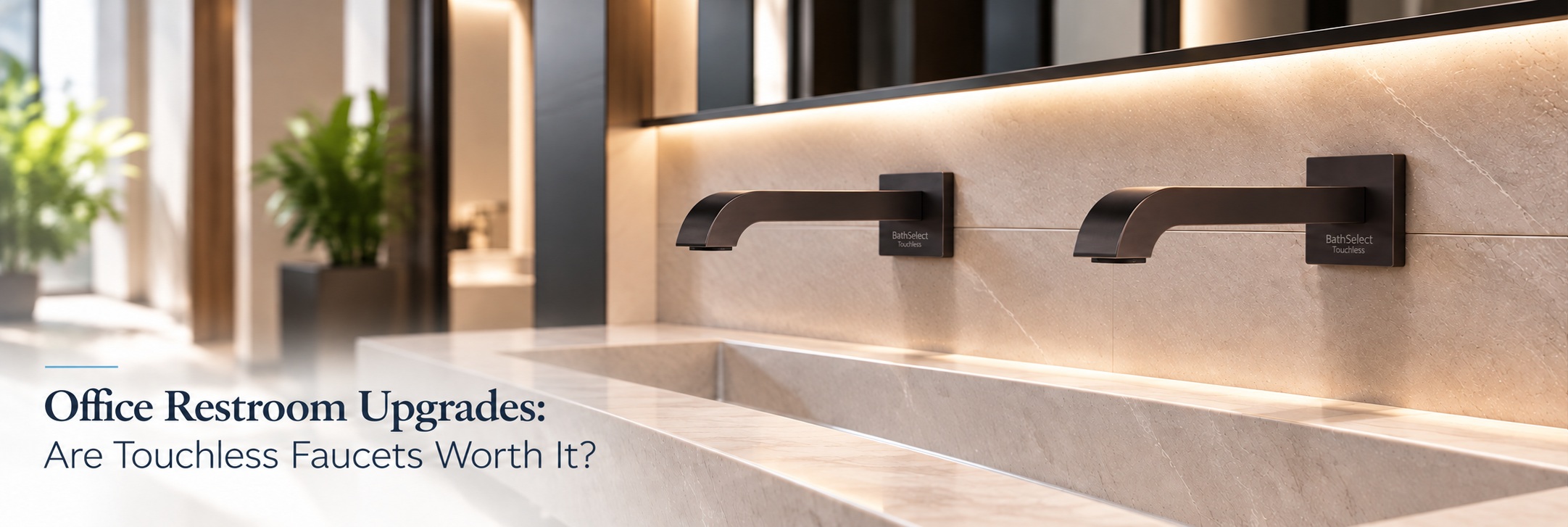
Office Restroom Upgrades: Are Touchless Faucets Worth It?
Touchless faucets promise a more convenient handwashing experience, controlled water delivery, and a contemporary appearance. But for office-building owners, facility managers, architects, and MEP engineers, the deciding question is whether electronic faucets provide measurable value over their operating life.
This guide examines initial costs, water-use scenarios, operating expenses, maintenance, accessibility, sensor reliability, and commercial specification requirements to help determine when a touchless restroom upgrade makes financial and operational sense.
Explore Touchless Faucet Systems → View Specification Resources
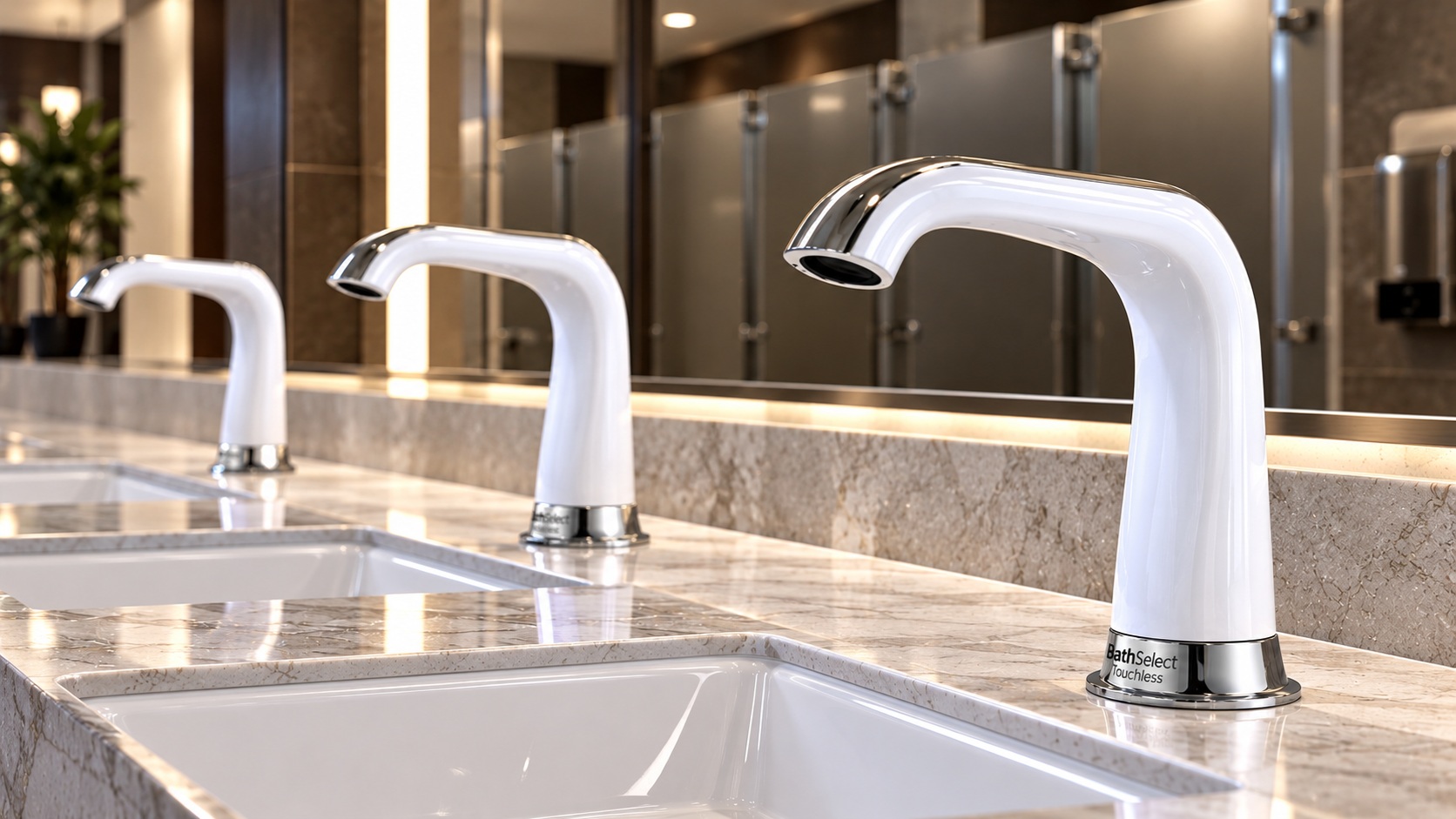
Are Touchless Faucets Worth It for Office Buildings?
Touchless faucets can be a worthwhile investment when the installation is matched to restroom traffic, existing water use, plumbing conditions, and maintenance capacity. Their principal advantages are hands-free activation, automatic shutoff, improved consistency of water delivery, and the ability to integrate with contemporary commercial restroom designs.
However, installing a sensor faucet does not automatically produce a lower utility bill. A well-maintained manual faucet with a low-flow outlet may already consume comparatively little water. Electronic faucets also introduce batteries or power supplies, solenoid valves, sensors, and control components that require periodic servicing.
For high-traffic commercial offices, multi-tenant buildings, corporate headquarters, and mixed-use developments, the strongest business case typically combines reduced unnecessary water flow with improved user convenience, easier standardized operation, and a coordinated facilities-maintenance program.
Why Commercial Offices Are Moving Toward Touchless Restrooms
A More Convenient Handwashing Experience
Sensor faucets allow users to activate water without turning a handle. This reduces direct contact with faucet controls, although regular handwashing, cleaning, and maintenance remain essential. Touch-free operation can be particularly valuable in shared restrooms serving tenants, visitors, and building staff.
Controlled Water Use
Automatic shutoff can limit water left running unnecessarily. Actual savings depend on the existing faucet, flow rate, activation duration, occupant behavior, and sensor settings. A retrofit should be evaluated using real operating conditions rather than assumed percentage savings.
Consistent Building Appearance
Coordinated sensor faucets and automatic soap dispensers create a uniform appearance across floors, tenant spaces, reception areas, and executive restrooms. Chrome, brushed nickel, matte black, and brushed gold can be specified according to finish durability, cleaning requirements, and interior design objectives.
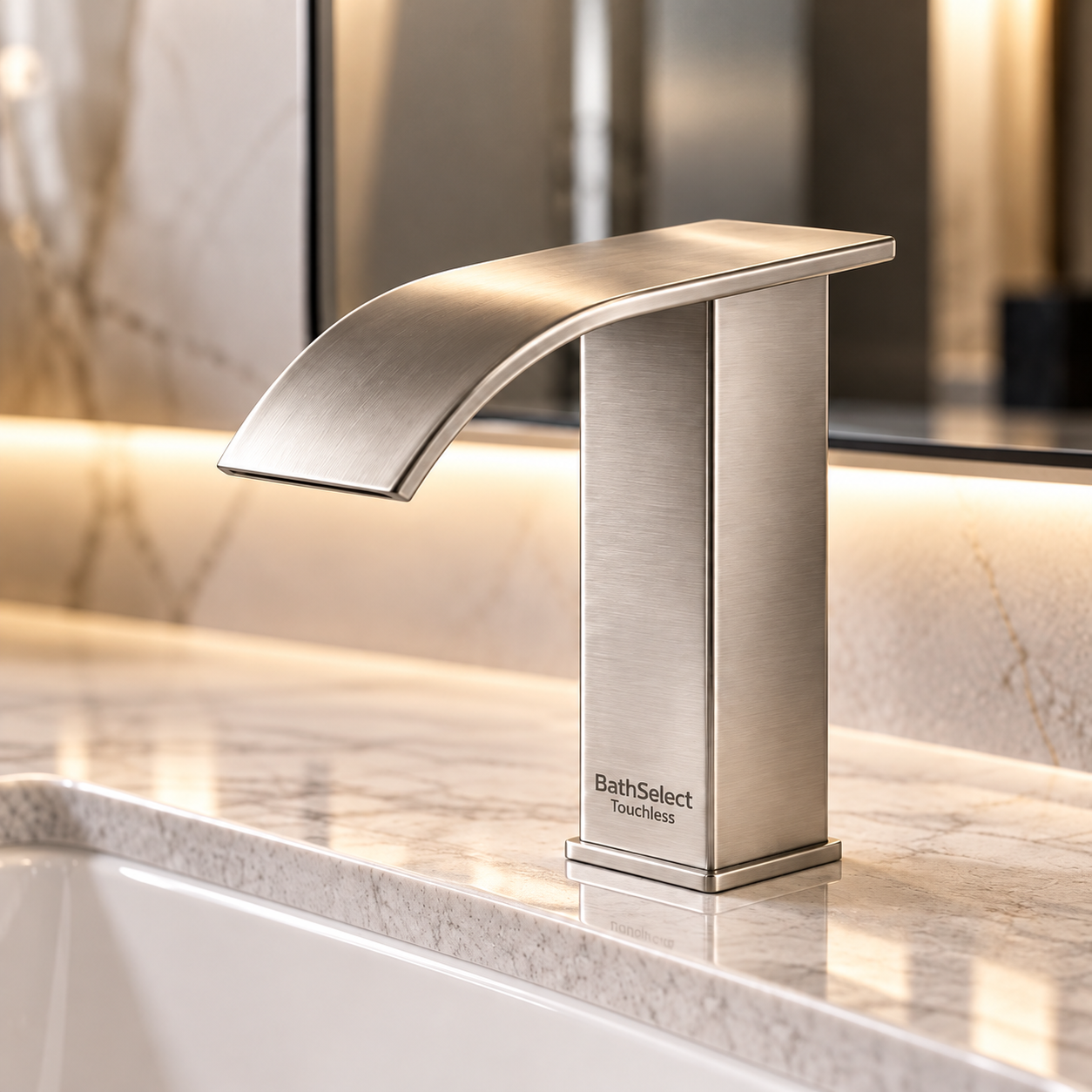
Touchless vs. Manual Faucets: What Changes for Building Owners?
| Evaluation Factor | Manual Commercial Faucet | Touchless Commercial Faucet |
|---|---|---|
| User activation | Requires a handle, lever, or push control. | Sensor activates water when hands enter the detection zone. |
| Water shutoff | Depends on user behavior or metering mechanism. | Typically automatic after hands leave the sensing area, subject to programmed delay. |
| Water efficiency | Can be highly efficient when equipped with a compliant flow restrictor. | Can reduce unnecessary run time; actual savings depend on settings and baseline use. |
| Initial investment | Generally simpler fixture and installation cost. | Typically includes electronic components and additional installation considerations. |
| Maintenance | Cartridges, seals, outlets, and mechanical parts. | Solenoid, sensor, control module, power supply, filter, and outlet maintenance. |
| Accessibility | Requires appropriately accessible controls. | Hands-free operation may simplify use; full fixture installation must still satisfy accessibility requirements. |
| Best application | Lower-use or cost-sensitive areas with suitable existing hardware. | Shared office restrooms, visitor areas, and managed high-traffic facilities. |
Understanding the Return on Investment
An office restroom upgrade should be assessed over several years, not simply by comparing purchase prices. A useful lifecycle analysis includes the initial installed cost, anticipated water and water-heating savings, electricity or battery expenses, labor, spare parts, and eventual replacement.
What Belongs in the Initial Budget?
- Commercial sensor faucet purchase
- Removal of existing fixture
- Deck-hole or countertop adaptation
- Supply and mixing-valve coordination
- Power supply or battery installation
- Sensor calibration and commissioning
- Training and spare-parts provision
What Belongs in Operating Costs?
- Water and sewer charges
- Hot-water energy where applicable
- Battery or electrical consumption
- Scheduled inspections and cleaning
- Solenoid and control-module replacement
- Sensor recalibration or troubleshooting
- Fixture downtime and service labor
An Illustrative Office Building Water-Savings Scenario
Consider an office building with 20 lavatory faucets and an estimated 80 activations per faucet each occupied workday. Assume 250 occupied workdays annually. The existing faucets operate at 1.5 gallons per minute with 12 seconds of actual water flow per use. The proposed automatic faucets deliver 0.5 gallons per minute for 10 seconds per use.
| Input | Existing Installation | Proposed Installation |
|---|---|---|
| Number of faucets | 20 | 20 |
| Activations per faucet per day | 80 | 80 |
| Annual occupied days | 250 | 250 |
| Flow rate | 1.5 GPM | 0.5 GPM |
| Average water-running duration | 12 seconds | 10 seconds |
| Estimated annual water consumption | 120,000 gallons | 33,333 gallons |
| Illustrative annual reduction | Approximately 86,667 gallons | |
At an illustrative combined water and sewer rate of $15 per 1,000 gallons, the scenario represents approximately $1,300 in annual water and sewer savings. Actual utility rates and demand patterns vary widely. Water-heating impacts and maintenance costs are excluded.
View the ROI calculation and payback methodology
Calculate Annual Water Consumption
Annual gallons = Number of faucets × Uses per faucet per day × Operating days × Flow rate (GPM) × Running duration (seconds) ÷ 60.
Calculate Annual Financial Savings
Annual utility savings = Annual gallons saved ÷ 1,000 × Combined water and sewer cost per 1,000 gallons.
Calculate Simple Payback
Simple payback = Incremental installed project cost ÷ Annual net operating savings.
As an example, a $12,000 incremental investment with $1,300 in annual gross utility savings and $300 in annual incremental maintenance costs produces $1,000 in net annual savings and a simple payback of approximately 12 years.
If savings also include verified hot-water energy reductions or lower service costs, payback may change. A detailed investment model should account for component replacement, discount rate, and expected fixture life.
Technical Specifications That Matter in Commercial Installations
Flow Rate and Hydraulic Performance
For public office lavatories, a maximum flow of 0.5 GPM is an important design benchmark in U.S. commercial plumbing applications, subject to applicable local codes.
Designers should verify the tested flow rate, working pressure range, aerator or laminar-flow outlet type, and compatibility with the building’s water supply.
Sensor Detection and Response
Sensor behavior must suit the basin geometry and user approach. The specified detection zone should avoid unintended activation from reflections, nearby surfaces, and routine cleaning activity.
Automatic Shutoff and Safety
Evaluate shutoff delay, maximum continuous run time, low-battery indication, and fault behavior. These settings affect water consumption, usability, and service demands.
Power Architecture
Battery-powered models may simplify certain retrofits. Hardwired models can be practical where electrical provision is available. Dual-power options should be checked for actual backup behavior and included equipment.
| Specification Item | What to Verify |
|---|---|
| Fixture construction | Body material, finish durability, replaceable components |
| Flow rate | Documented GPM and test pressure |
| Operating pressure | Manufacturer’s minimum and maximum water pressure |
| Sensor | Detection distance, adjustment method, response and false-trigger behavior |
| Water control | Solenoid type, strainer, shutoff, service isolation |
| Power | Battery type, DC voltage, AC adapter and backup availability |
| Temperature control | Mixing valve provision and applicable scald-protection requirements |
| Installation | Mounting hole, deck thickness, spout reach, hose connections |
| Moisture protection | Documented IP rating for each applicable electronic enclosure |
| Maintenance | Access clearance, spare parts, diagnostics, service instructions |
| Compliance | Applicable plumbing, accessibility, material and electrical requirements |
BathSelect offers commercial products with documented infrared sensing, automatic shutoff, and alternative power arrangements. Exact performance figures and configurations should be checked against each model’s current specification sheet.
View Commercial Chrome Sensor FaucetIP Ratings and Moisture Protection for Electronic Bathroom Fixtures
Because automatic faucets use electronic components near washbasins and plumbing connections, protection from moisture is an important specification issue. Electrical controls, connectors, battery compartments, and solenoid enclosures should be appropriate for their installed environment.
An IP rating, under the IEC 60529 classification system, describes the level of ingress protection provided by an enclosure against solid objects and water. It does not establish that an entire faucet installation is waterproof under all conditions.
How an IP Code Works
In a designation such as IP65, the first digit identifies protection against solids and access to hazardous parts, while the second digit identifies protection against water.
The rating must be read together with the manufacturer’s installation instructions and the conditions under which it was tested.
Questions for the Specifier
- Which component has the declared IP rating?
- Is the rating supported by product documentation?
- Is the controller installed within the permitted location?
- How are electrical connections protected?
- Can the enclosure be accessed without exposing it to leaks?
Learn more about specifying moisture-resistant electronic fixtures
For below-counter installations, consider condensation, splash exposure, cleaning methods, flexible supply connections, and possible leaks from valves or traps. Locate the controller where it can be inspected and serviced without unnecessary exposure to water.
Protect wiring from sharp countertop edges and moving service components. Follow manufacturer requirements for cable routing, enclosure mounting, grounding where applicable, and electrical separation.
Verify that the manufacturer’s declared ingress-protection performance is suitable for the exposure expected in the project. Do not substitute an assumed IP rating for a documented specification.
Accessibility and User-Centered Restroom Design
Hands-free controls can make lavatory operation easier for people with different levels of manual dexterity. However, a sensor faucet alone does not establish compliance with the Americans with Disabilities Act.
Accessible commercial lavatories must still be coordinated for appropriate counter height, clear floor space, knee and toe clearance, reach, and protection from exposed hot plumbing and sharp surfaces.
The U.S. Access Board identifies motion-activated fixtures as a potentially accessible control approach, while other aspects of the completed restroom remain subject to the applicable standards.
Design Coordination
- Appropriate forward access to the lavatory
- Usable faucet activation zone
- Spout reach suitable for the basin
- Accessible soap dispensing
- Protected exposed piping
- Unobstructed maintenance access
Operational Considerations
Test the fixture with different hand positions and approach angles. Ensure the sensing field permits convenient use without requiring awkward reaching.
Consider how the installation will behave during power interruption, cleaning, sensor faults, and scheduled service.
Technical reference: U.S. Access Board — Lavatories and Sinks .
Where Touchless Faucet Investments Make Sense
Corporate Offices and Multi-Tenant Buildings
Standardized sensor fixtures can simplify the user experience across multiple floors and tenant areas. Centralized procurement, common spare parts, and consistent commissioning procedures can support facility-wide maintenance.
Commercial Hotels and Hospitality
Touchless technology can support contemporary restroom aesthetics in hotel lobbies, convention areas, restaurants, and conference centers. Finish selection, sensor responsiveness, and quiet operation should reflect the intended guest experience.
Shopping Malls and Retail Centers
Heavy and variable restroom traffic makes automatic shutoff, durable construction, service access, and vandal resistance especially important. Maintenance teams should evaluate daily activations and component replacement requirements.
Stadiums and Event Venues
Large peak-demand periods require consistent activation, appropriate water pressure, dependable power, and effective servicing procedures. Fixture selection should account for simultaneous use and fast cleaning cycles.
Airports and Transportation Facilities
Extended operating hours and diverse user groups increase the importance of accessibility, sensor reliability, moisture protection, and readily available replacement parts.
Educational and Public Facilities
Schools, universities, libraries, and municipal facilities may benefit from contact-free use and automatic shutoff. Equipment must be selected for actual usage, abuse resistance, and maintenance budgets.
Choosing a Commercial Touchless Faucet System
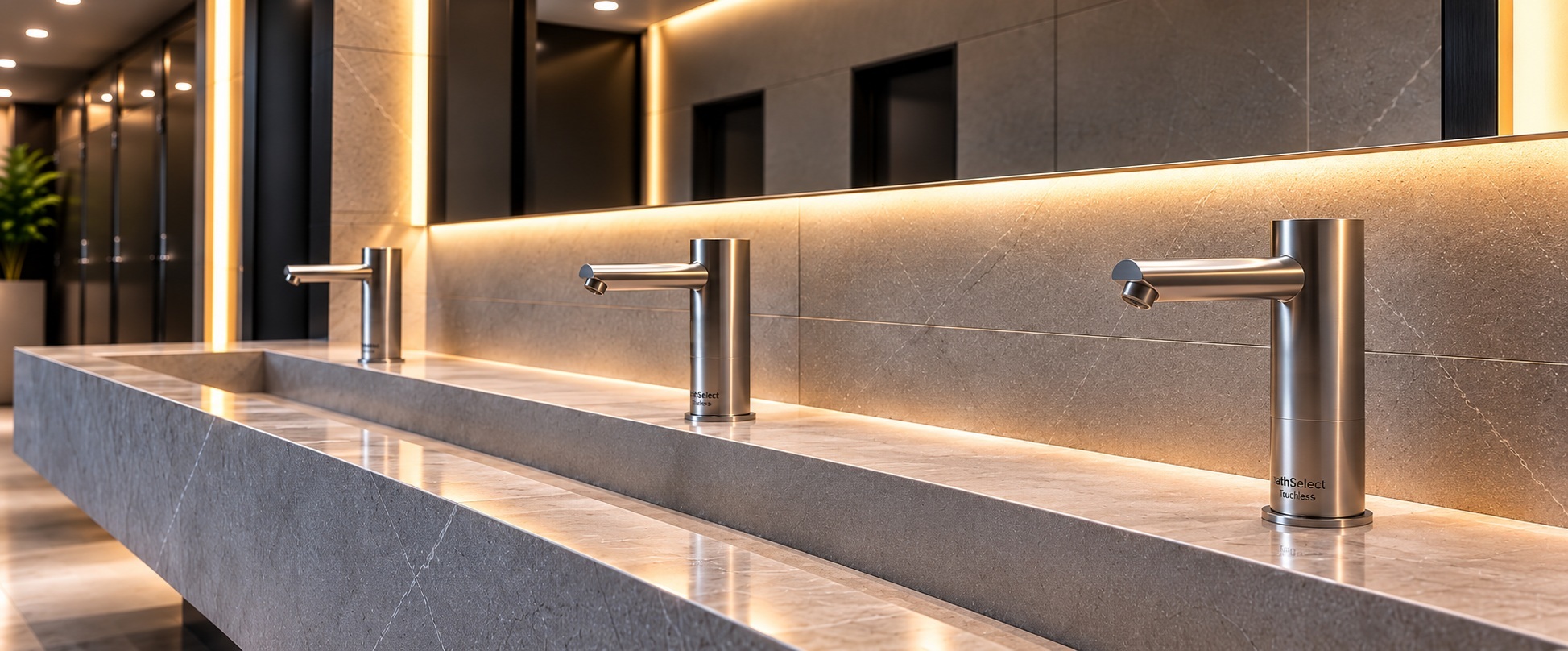
BathSelect offers sensor-operated fixtures for new construction, renovation, and coordinated commercial restroom projects. Product selection should begin with performance requirements, installation geometry, and maintenance needs rather than appearance alone.
Commercial Automatic Touchless Faucet
A chrome infrared sensor faucet option intended for commercial installations. The product information describes automatic operation, a selectable power configuration, and adjustable shutoff behavior.
Explore Fixture →Matte Black Thermostatic Sensor Faucet
A commercial-oriented option combining sensor activation with temperature-control functionality. Confirm the supplied configuration, sensor adjustment, power requirements, and water-temperature protection details before specification.
Explore Fixture →Automatic Faucet and Soap Dispenser Set
Coordinated sensor faucet and automatic soap dispenser assemblies can create a consistent touch-free handwashing station for office buildings, hospitality, and public restrooms.
Explore Coordinated Set →BathSelect Touchless Collections
Explore the broader product families and compare commercial suitability, construction, finishes, flow options, and specification resources across different model types.
Explore Collections →Installation and Maintenance: Protecting the Investment
Long-term faucet performance depends on correct installation, commissioning, and maintenance. For large office projects, a repeatable installation standard can reduce unnecessary variation between restrooms.
Before Installation
- Confirm supply pressure and water quality.
- Check the basin-to-spout alignment and splash behavior.
- Confirm mounting holes and countertop thickness.
- Locate temperature controls and service valves.
- Provide suitable protected electrical or battery access.
- Confirm access to filters, valves, and control equipment.
During Commissioning
- Check for supply and drain leaks.
- Test activation using normal hand positions.
- Verify shutoff delay and maximum running time.
- Observe nearby fixture and reflection interference.
- Measure delivered water temperature and flow.
- Document final configuration for facilities staff.
Maintenance Priorities
The most practical preventive-maintenance plan addresses both conventional plumbing and the additional electronics of an automatic faucet.
- Clean outlet screens and strainers as instructed.
- Inspect hoses, filters, and solenoid connections.
- Monitor low-battery or diagnostic indicators.
- Clean sensor windows using approved materials.
- Check for unintended activation or delayed shutoff.
- Maintain an inventory of compatible spare parts.
Maintenance frequency should be based on manufacturer guidance, actual traffic, water conditions, and observed service history.
View detailed guidance for multi-floor retrofit projects
Begin with an inventory of existing lavatories, faucet types, deck holes, supply connections, shutoff valves, power availability, and service clearances.
Identify a pilot restroom with representative traffic. Measure baseline consumption where possible, then install and commission the proposed system.
Observe sensor performance and service needs during normal use before extending the specification to additional floors.
For larger deployments, use a consistent equipment schedule, documented component list, commissioning checklist, and maintenance procedure. Compare measured results against initial assumptions before finalizing the capital expenditure.
Common Mistakes That Can Reduce Touchless Faucet ROI
Assuming All Sensor Faucets Save the Same Amount of Water
Water savings depend on flow and operating duration. A poorly adjusted sensor can remain active longer than intended. A low-flow manual fixture may already perform efficiently.
Ignoring Service Access
Concealed controls are visually desirable but must remain accessible. Difficult access can increase labor time and fixture downtime.
Overlooking Power Requirements
A hardwired model may require additional coordination with electrical trades. A battery model requires accessible replacement and an appropriate service plan.
Choosing a Faucet Without Testing the Basin
Incompatible geometry can produce splash, poor hand-position detection, or unintended operation. The faucet and basin should be evaluated together.
Frequently Asked Questions
Do touchless faucets actually save water in office buildings?
They can reduce unnecessary water flow through automatic shutoff, but savings depend on the current faucet flow rate, running duration, user behavior, and sensor configuration. A measured baseline offers the most reliable comparison.
Are touchless faucets more expensive to maintain?
Electronic faucets have sensors, control modules, solenoids, and power components beyond those found in many manual faucets. Their service cost depends on model reliability, installation conditions, traffic, and maintenance practices.
Should commercial offices use battery-powered or hardwired sensor faucets?
Battery power can be useful for retrofits with limited electrical access. Hardwired systems may be convenient in new construction or major renovations. Review available backup options and expected servicing needs for each product.
What flow rate should a public restroom faucet have?
In U.S. public restroom applications, 0.5 GPM is a widely used maximum design benchmark, subject to applicable plumbing codes and project requirements. EPA WaterSense labeling for private bathroom sink faucets should not be confused with commercial public lavatory requirements.
Are touchless faucets ADA compliant?
Motion activation can support accessible operation. However, compliance depends on the complete lavatory installation, including approach clearances, dimensions, reach, and protection from exposed piping. Verify the applicable standards for the project location.
Do commercial touchless faucets require an IP rating?
The electronic enclosures must be suitable for their environment and satisfy applicable electrical requirements. Where IP ratings are declared, confirm the rating, component coverage, and supporting manufacturer documentation. Do not assume every component has the same protection level.
When is a touchless faucet upgrade most financially attractive?
Potentially favorable circumstances include high restroom traffic, inefficient existing fixtures, avoidable run time, suitable infrastructure, and a maintenance program capable of supporting the electronic systems. A site-specific lifecycle estimate is needed to determine the financial result.
Making the Right Investment Decision
Upgrading to touchless faucets is not simply a technology purchase. It is a decision about building operation, fixture performance, accessibility, water management, occupant experience, and long-term asset maintenance.
For office buildings undergoing renovation, the strongest approach is to assess existing restroom performance, define measurable operating objectives, compare suitable fixture configurations, and validate results through a pilot installation where practical.
A properly specified electronic faucet system can provide a reliable, modern handwashing experience. Whether it delivers an attractive financial return depends on the conditions of the individual building.
Plan a Commercial Restroom Upgrade with BathSelect
Explore touchless faucet and automatic soap dispenser systems designed for commercial restrooms, hospitality interiors, and specification-driven building projects. Compare available configurations and review individual product documentation to select the right solution for your project.
Browse Touchless Systems → Explore Architect Resources →Technical References and Further Reading
The following resources provide background on commercial faucet efficiency, accessible plumbing design, and product selection.