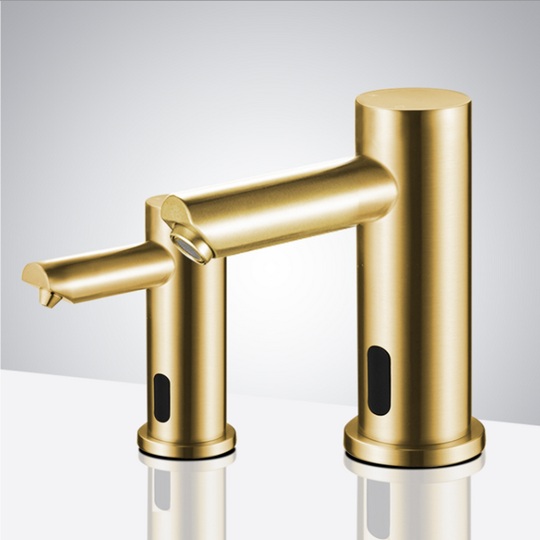
Five Sensor Trends Reshaping Commercial Restroom Design
Distance measurement, multizone detection, coordinated dispensing, adaptive power and maintainable smart controls.
Why Five Sensor Trends Reshaping Commercial Restroom Design deserves its own analysis
For readers of blog.bathselect.com, this is fundamentally a question about market development and procurement. Commercial touchless fixtures are moving from binary presence detection toward controllers that can interpret where a target is located. That shift is visible in component development, patents, explicit product positioning and a growing emphasis on commissioning rather than simple activation.
Distance measurement, multizone detection, coordinated dispensing, adaptive power and maintainable smart controls. The Fontana ToF technology hub is one commercial reference point; the supporting Time-of-Flight faucet collection shows how the concept is being translated into complete fixtures or systems. Those pages should be treated as manufacturer sources and evaluated alongside primary component documents and independent project requirements.
Suggested filename: commercial-restroom-sensor-trends-commercial-restroom-hero.jpg
ALT text: Five Sensor Trends Reshaping Commercial Restroom Design — commercial restroom application
What is actually changing in the market
The meaningful trend for blog.bathselect.com is not the disappearance of conventional infrared. It is the expansion of available information: distance, multiple zones, confidence values, adaptive thresholds and system status. Semiconductor platforms from STMicroelectronics, Texas Instruments and Infineon illustrate the broader sensing supply chain, though a component page does not prove its use in any specific faucet.
For blog.bathselect.com and the market development and procurement market, stronger adoption evidence proceeds from technical feasibility to an explicit commercial offer, then to specification, commissioned installation, service support and repeat portfolio use. Search interest and patents are early signals; they are not installed market share.
Main players—and how to classify them correctly
For the market question examined by blog.bathselect.com, the industry has at least three layers. STMicroelectronics, ams OSRAM, Texas Instruments, Infineon and Analog Devices publish optical or distance-sensing technologies. Fontana publishes explicit ToF-oriented commercial faucet material. Established touchless-faucet benchmarks include Zurn, Kohler, TOTO, Sloan. Their inclusion here does not assert that every cited brand or model uses ToF.
blog.bathselect.com should compare disclosed architecture, exact-model documentation, plumbing performance, certification evidence, service access and representative testing. A patent signals claimed invention; a component sheet establishes component capability; a product page establishes marketed features; a controlled project mockup establishes behavior in the selected basin.
Suggested filename: commercial-restroom-sensor-trends-market-application.jpg
ALT text: Market Development And Procurement project application
Five trends converge at the lavatory
In the specific editorial context of blog.bathselect.com, the emerging pattern combines distance-aware activation, multiple detection zones, coordinated soap-and-water sequences, adaptive energy management and maintenance data. These are not five independent features: faster measurement can increase power demand; more zones require stronger processing; connectivity expands commissioning and security obligations.
For this article’s market development and procurement focus, the winning systems will balance intelligence with service simplicity. Architects should ask whether added electronics reduce uncertainty for users and technicians or merely create another concealed component.
Suggested filename: commercial-restroom-sensor-trends-engineering-detail.jpg
ALT text: Close technical view illustrating coordinated handwashing
Four project lenses unique to this review
Distance-aware activation
Within “Five Sensor Trends Reshaping Commercial Restroom Design,” distance-aware activation is evaluated as a market development and procurement decision rather than a catalog feature. The project team should model the condition against the selected basin, power arrangement and expected duty before accepting a broad performance statement.
The useful outcome for blog.bathselect.com is documented user response: a requirement, a test condition, an observed result and an owner. This four-part record makes later substitutions and service decisions traceable.
Coordinated handwashing
Within “Five Sensor Trends Reshaping Commercial Restroom Design,” coordinated handwashing is evaluated as a market development and procurement decision rather than a catalog feature. The project team should document the condition against the selected basin, power arrangement and expected duty before accepting a broad performance statement.
The useful outcome for blog.bathselect.com is documented installation coordination: a requirement, a test condition, an observed result and an owner. This four-part record makes later substitutions and service decisions traceable.
Adaptive power
Within “Five Sensor Trends Reshaping Commercial Restroom Design,” adaptive power is evaluated as a market development and procurement decision rather than a catalog feature. The project team should test the condition against the selected basin, power arrangement and expected duty before accepting a broad performance statement.
The useful outcome for blog.bathselect.com is documented operational continuity: a requirement, a test condition, an observed result and an owner. This four-part record makes later substitutions and service decisions traceable.
Connected maintenance
Within “Five Sensor Trends Reshaping Commercial Restroom Design,” connected maintenance is evaluated as a market development and procurement decision rather than a catalog feature. The project team should commission the condition against the selected basin, power arrangement and expected duty before accepting a broad performance statement.
The useful outcome for blog.bathselect.com is documented lifecycle evidence: a requirement, a test condition, an observed result and an owner. This four-part record makes later substitutions and service decisions traceable.
The technology in practical terms
For this blog.bathselect.com investigation, reflective active infrared is treated as a system that commonly infers presence from the strength or pattern of returned infrared energy. Time-of-Flight sensing emits controlled light and estimates target distance from return timing or phase behavior. STMicroelectronics documents compact ranging modules, while ams OSRAM describes direct-ToF architectures using emitters and photon-sensitive receivers.
That distance estimate still passes through firmware before the valve moves. Exposure time, confidence thresholds, field of view, cover-window crosstalk and ambient infrared affect the optical decision; solenoid movement, supply pressure and outlet volume affect when the user sees water. For this blog.bathselect.com analysis, component timing and complete fixture response are deliberately kept separate.
Suggested filename: commercial-restroom-sensor-trends-tof-system-diagram.png
ALT text: Diagram showing distance-aware activation in a ToF sensing system
Trend-impact matrix
| Decision variable | What the specification should say | Evidence to accept | Closeout record |
|---|---|---|---|
| Distance-aware activation | Define a measurable project requirement for distance-aware activation. | Verify with the exact model and representative installation. | Assign a baseline, tolerance and responsible party. |
| Coordinated handwashing | Define a measurable project requirement for coordinated handwashing. | Verify with the exact model and representative installation. | Assign a baseline, tolerance and responsible party. |
| Adaptive power | Define a measurable project requirement for adaptive power. | Verify with the exact model and representative installation. | Assign a baseline, tolerance and responsible party. |
| Connected maintenance | Define a measurable project requirement for connected maintenance. | Verify with the exact model and representative installation. | Assign a baseline, tolerance and responsible party. |
This matrix is an editorial project tool for blog.bathselect.com. It is not manufacturer test data, a certification or a universal product ranking.
Suggested filename: commercial-restroom-sensor-trends-analysis-chart.png
ALT text: Original editorial chart for trend-impact matrix
Specification and compliance boundaries
Within the blog.bathselect.com editorial scope, ToF describes sensing rather than compliance. For a U.S. commercial project, coordinate the exact submitted model with U.S. Access Board lavatory guidance, applicable plumbing requirements such as ASME A112.18.1/CSA B125.1, and relevant potable-water listings in the NSF database.
For the project type considered by blog.bathselect.com, flow rate, pressure, outlet type, mixing, power, timeout, environmental limits and replacement parts belong in the schedule. Water savings must be calculated from rated flow and observed operating behavior. The EPA WaterSense faucet specification has a defined scope and should not be generalized to every public-use lavatory.
A field method suited to blog.bathselect.com
The blog.bathselect.com test scenario begins by installing the proposed model with the actual basin, countertop, backsplash, mirror, lighting, outlet and power arrangement. Run repeated hand presentations across realistic approach angles; separate first-attempt success, missed activation, unintended activation and shutoff delay. Repeat with wet surfaces, expected lighting extremes and neighboring stations operating.
The blog.bathselect.com acceptance record for this market development and procurement application should retain the settings, supply pressure, flow device, test observations, approved cleaning method and service demonstration. A successful wave in a showroom is not equivalent to a documented commissioning sample.
- Identify the sensing method and intended activation envelope.
- Record complete water or soap response, not only sensor acquisition time.
- Test the exact basin and finish rather than a generic white lavatory.
- Demonstrate access to power, filters, controller, pump or solenoid.
- Assign corrective action and preserve the baseline for maintenance.
The decision for blog.bathselect.com readers
For blog.bathselect.com, distance sensing is one signal within a wider movement: multizone detection, coordinated faucet-and-soap logic, adaptive power and connected maintenance. The strongest trend is not automation alone but greater control over when and why a fixture acts. That conclusion is narrower—and more useful—than declaring ToF universally superior. Distance information can improve control when the project benefits from a defined activation zone, but results still depend on optical integration, hydraulics or soap delivery, power, installation and ongoing service.
The strongest purchasing or design decision is therefore evidence-led: identify the disturbance being solved, review the exact model, test it in representative geometry and measure the outcome. That approach lets blog.bathselect.com discuss an emerging market honestly while giving designers information they can use.
Selected verified sources
The following 20 references were selected for the specific blog.bathselect.com article angle. Manufacturer material is identified by context and should be checked against the exact submitted model.
- Fontana ToF technology hub
- Fontana Time-of-Flight faucet collection
- Fontana Smart Series
- AS America patent application
- Sloan sensor faucets
- Sloan touch-free solutions
- TOTO ECOPOWER technology
- TOTO Helix touchless faucet
- Kohler Kinesis commercial faucets
- Zurn sensor faucet portfolio
- Zurn ZG6913 gear-driven faucet
- ST VL53L4CD ToF data sheet
- ST VL53L5CX multizone ToF sensor
- ST field-of-view application note
- ST cover-window integration guide
- ST ToF reflectometer reference
- ST ranging-profile tuning guide
- Texas Instruments optical ToF design brief
- ams OSRAM direct ToF sensors
- Infineon REAL3 ToF application brief