Coordinating a Hotel Bathroom: How to Match Shower, Faucet, and Sink Series Without a Finish Mismatch
A hotel bathroom typically draws from four to six separate product categories — shower system, sink faucet, tub faucet, shower head, sometimes a smart bathroom module. Ordering each in isolation is the single most common cause of a renovation that looks slightly off once it’s installed.
Individually, a shower system, a sink faucet, and a tub filler are simple purchasing decisions. Coordinated across a guest room — and across every guest room on a floor — they’re a different problem entirely, and one that shows up not in any single fixture’s quality but in how they sit next to each other once installed.
Why coordination is harder than it looks
The failure mode here is rarely a bad individual fixture. It’s a chrome sink faucet that reads slightly warmer or cooler than the chrome shower system three feet away, because the two were sourced from different product lines with different plating processes. Under bathroom lighting, a finish mismatch that’s invisible on a spec sheet becomes visible in the room — and once a guest notices one mismatched pair of fixtures, they tend to notice the rest.
Beyond the visual issue, coordinating within fewer product families also simplifies procurement and maintenance: fewer distinct SKUs to track, more overlap in cartridge platforms and replacement parts, and warranty terms that are easier to manage when they’re not scattered across half a dozen unrelated purchase orders.
The categories a typical hotel bathroom draws from
A full guest bathroom renovation usually touches most of these categories, even in a fairly standard room layout.
- Shower systemThe full valve-and-trim assembly controlling water delivery to the shower head and any body sprays.
- Shower headFixed, handheld, or rain-style head — sometimes ordered separately from the shower system it’s paired with.
- Bathroom sink faucetDeck-mount or wall-mount lavatory faucet, touchless or manual.
- Bathtub faucetTub filler, often specified separately even when it shares a finish family with the shower system.
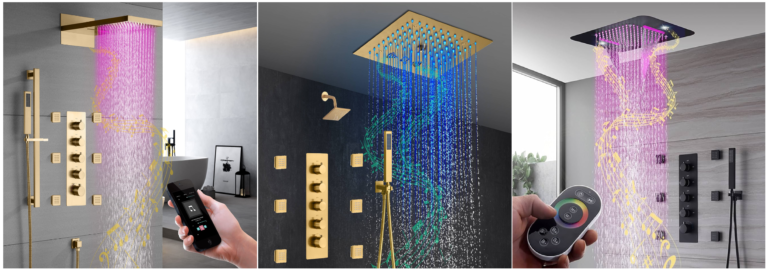
- LED shower headA specialty category on its own — temperature-reactive or accent lighting integrated into the shower head.
- Smart bathroom systemsDigital or app-connected controls, increasingly specified for flagship or renovated luxury properties.
What “same finish” should actually mean when specifying
“Chrome” and “chrome” from two different product families aren’t a guarantee of a visual match — plating process, base metal, and even lighting conditions can make two technically-correct chrome finishes read differently side by side. The more reliable approach is specifying fixtures across categories from within the same manufacturer’s coordinated line whenever possible, since a single manufacturer has direct control over plating consistency across its own product families in a way that mixing sources doesn’t guarantee.
Mixed-source finish
Sourcing sink, shower, and tub fixtures from different manufacturers under the same finish name — visual match is not guaranteed.
Coordinated line
Sourcing across categories within one manufacturer’s coordinated series — plating consistency is managed under one process.
A practical checklist for a multi-room renovation
- Are all fixture categories for the room being sourced from the same coordinated series, not mixed vendors?
- Does the finish name match exactly across categories — not just “similar,” but the identical named finish within the line?
- Do the warranty terms align across categories, or does one product have a shorter cartridge warranty than the rest?
- Is there cartridge or parts overlap between the shower, sink, and tub fixtures selected, to reduce the number of distinct SKUs the property has to stock?
- Has one full bathroom been mocked up under actual room lighting before finalizing the order for every floor?
A mismatched finish is rarely a manufacturing defect. It’s a coordination gap between separately-sourced product lines that never should have been compared side by side in the first place.
Coordination is a lifecycle decision, too
Sourcing within one coordinated line doesn’t just protect finish consistency — it’s also what makes standardized parts-stocking possible across a property.